
Q&A: How to Move Through the Madness with Dr. Andrea Jacobo
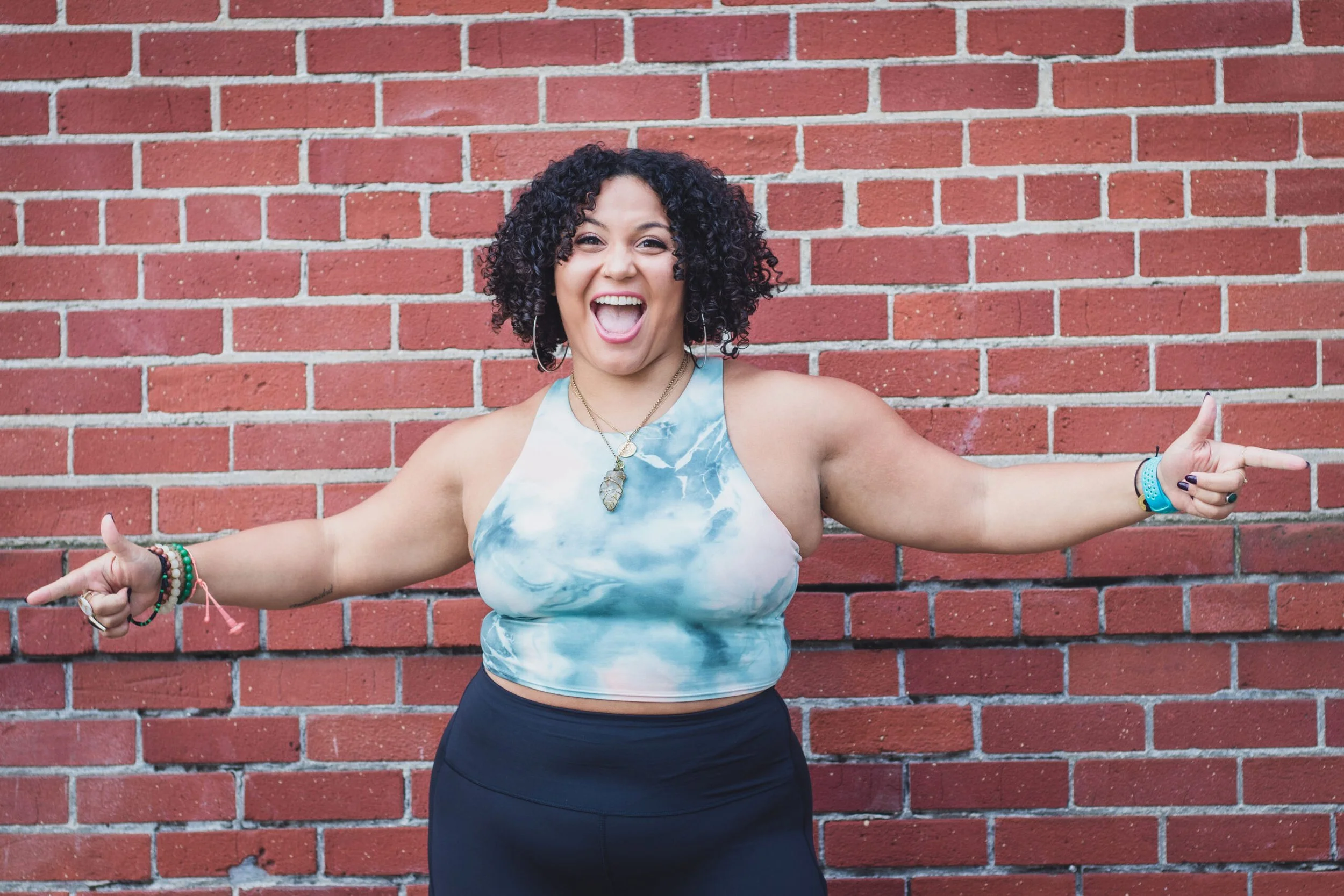
Dr. Andrea Jacobo
Dr. Andrea Jacobo, creative wellness practitioner, researcher and poet, is like really creative. Read the Q&A from our interview available on YouTube, Spotify, and Apple Podcasts.
So tell me a little bit about how you got into creative wellness and how you practice creative wellness.
So I think I can go back to undergrad. My background is in exercise physiology. I got a degree in kinesiology. And that came from my love of exercise and my love of movement. I am a Zumba instructor. I dance. I'm also first generation Dominican American. So in my household, there was always music, there was always dancing.
There was always a formal way of expressing ourselves through either photography, like my father or interior design like my mother. But both of them, who are professionals that didn't really exercise their artistic connection. My older sister is a musician and artist. And because of being of an immigrant background, my mom was like, “We already have one artist in the family.”
We can’t have two. It can't happen. So I went to the sciences, right?
As I went through schooling, I realized how much art and how much movement really centered me. I needed exercise to keep me focused as a person who has some neuro-spiciness. I feel like exercise helped me kind of focus.
And there's a lot of studies that show mental clarity when you're fully exercised. So I studied that, and fast forward to getting my dissertation, or just finishing my dissertation. I found myself looking at how art is a way of healing. And through all of these explorations, creative wellness kind of emerged through my work in the community, through my own discovery, through the multiple nights of like, just dreading school.
But always finding a way to dance, to move.
And, I also am a practicing yoga instructor. And when you think about the chakras, the energy systems and the root chakra, that's where your fear is. That's where your creativity is. So when I realized that dancing and moving, especially moving the hips and what we call just shaking some ass.
It relieves tension. It relaxes you. It also opens up your creativity and removes fear. And so with all that kind of encompassing, creative wellness emerged as something like: how do I name this, these different ways in which I show up as a researcher, as a practitioner, as an artist myself, as a poet.
And also just being able to tap in more into what I want to do creatively. I think that's where we see this emergence of creative wellness coming.
It is becoming a movement. And I firmly believe that creativity is synonymous with healing like you talked about with your art. Were there any struggles or doubts that you worked through with creativity to help you heal?
I think the pandemic really shifted everybody and rattled our world, both internally and externally and collectively. And for me, that's when I actually started going back to writing. I've always written, I've always had multiple notes, I have journals. And it was during the pandemic and I started sharing my poetry again and doing spoken word.
And I was also a part of the protests back in the Bay. And I was asked to do a poem for one of the rallies that we were having. And so I saw all these different ways in which my words were healing me as well as healing others. And so I think that was really what pushed me to tap into my artistry and my writing.
And even today, I still kind of struggle with the fact to say that I'm an artist because I didn't go to art school. I haven't had a chance to really dive into that practice until now. Until recently, like the last five years. Honestly, I was tired of, like, having to do the scientific—using my left brain that my right brain was just like, “Andrea, we need to do something because you're not going to be happy.” And so it wasn't until that that I started tapping in more. And the Memphis community really like helped encourage that; with We Keepin’ It P, a poetry collective that encourages people to just write and just share their poetry at open mics.
That really helped me out with being on stage and all that.
What was it like to finally be able to share your poetry? What was going through your head? What was that process like?
It's scary as hell. Because these words mean a lot. These are your inner thoughts and it's either about a situation or a memory. I definitely use memory. I always talk about liminal spaces in my work of like, what does it mean? What are the feelings between words and between a shared expression? I always think about—when I was younger, I would always be very observant and I would kind of observe little things.
And I always just remember small things in the room or small things in the conversation. And I always think about that. But it takes a lot to show who you are, right? And to find spaces that allow you to feel safe enough to share, that you're encouraged. A lot of my poetry is in Spanish and English, and so finding spaces that embrace that and also encourage that was very helpful for me. I think the reaction of people, they're like, “Oh my God, Andrea, your piece is beautiful.”
And, “Wow, it really moved me. You brought me to tears.” Or, ”That was so, healing for me.” That's what makes me keep going. And there's even flows, right? I actually stopped writing for, like, a year because of me trying to finish my dissertation. I stopped everything.
So it wasn't until last year that I started to write again. And you need to take a break. Sometimes you gotta find yourself and what you really want to do. The next thing is to actually share more, right?
Are there moments when you’re working out, dancing, that you get ideas? What is that like for you?
All the time. So sometimes it's music first. I love music. I listen to music all the time. All types of music. A song really encourages me to move and dance, and that makes me think. And then I start moving, and then I have these words coming to mind. It's like little nuggets.
And either I have to write it down at that moment or just enjoy that movement and the words that are coming in. The last poem I shared online, I actually wrote it when I was walking. What I was seeing and what I was feeling, I wrote it down. And it's just different. It came from listening to music. I find especially if music is very rhythmic like house music.
But I also love R&B, and I love rap, and I love hip hop, and I love reggaeton, I love merengue, and I love bachata. It's through that mixture of music that allows me to tap into what I'm feeling.
And especially if I'm experiencing something challenging in my life or I have anxiety about something, those moments that I am in motion allows me to process, especially from the body.
How do you motivate someone or yourself to get into the habit of exercising? Because it truly has changed my life in terms of being less depressed, especially. It's scientifically known that it can lessen the symptoms of it.
What do you love? How would you translate that into your exercise? How does that translate into you being active?
I found that when we tap into what people like, especially in terms of exercise, that's when people get connected.
Why does CrossFit work? There's a sense of community.
You go through a really hard workout and there's someone on the other end saying, “You can do this.” And there's an environment for someone to feel accepted, to feel loved, to try something challenging, but also in a way that is fun for them.
And so throughout my career, that's the best way of motivating people. I have been saying this thing lately that I “broke up with the gym.” I broke up with the gym because the way in which people were trying to tell me, “You need to have X amount of ways to show that's how your gym person, like your reps and sets and pain is no gain.”
And I hate all that. And I was a part of that. You know, I was a trainer. I studied exercise. I felt that that was the best way. I was hurting myself. Not just physically, but also emotionally. Psychologically.
How are you able to keep yourself motivated to do something consistently? Because it's about consistency. Because of a challenging relationship that I had that—he pushed me to exercise and pushed me to eat well. I did the opposite. Don't tell me what to do.
And a place that I love so much, which was a gym, I came to hate it. And so I had to rewire my brain, create a different relationship, tap into myself. And that's how I really went into yoga and Pilates, and different formats of exercise, going back to dance, things that brings joy.
That's what helps motivate people to continuously do something. Everyone's different. The gym is maybe the way in which they feel joy, but not everybody is meant to be in the gym.
It's not just exercise, it's also eating. It's also what are you consuming. Who you are around. What stress you have around you. Water intake is important too because we are about 70% water.
Through your research and getting your doctorate, were there any insights about health linked with creativity that really surprised you? Or things you learned that you could use for your own practice?
There was a study that was done about how declaring your testimony, sharing who you are, sharing what you've been through, is a form of healing. I think it's Cienfuegos, 1983. I used this in my dissertation because what I was looking at was like how people reclaim spaces politically, socially, and physically.
That was my question. And that was surprised me the most. I knew it, but I got a data point. I had an actual article that kind of connects—of how mental health and declaration of your own testimony in political spaces, but also using it as an art form to declare yourself—it is all healing.
It's all encompassing. I feel like that's how art shows up for me and for people. It is declaring who they are, what they've been through and what they see in the future and what's meant to be in this world today.
Now that you're finished with your dissertation, do you have any creative projects bubbling up? What is the future of your creativity or do you just let it happen as it happens?
Right now I'm just letting things happen as it happens. But I'm also being intentional in sharing more with folks.
Another thing I found in my dissertation—DJ Rich Medina did work with the Institute of Othering and Belonging in Berkeley. And he has this segment about how parties are congregations. And parties are healing because of the way in which we come together. We're dancing.
We're in the sync with joy and love. It's important for us to continuously be in those spaces and those ciphers. Those ciphers of love. And I feel like that's how this work is emerging. Sharing out more of what I do is the way I'm showing up.
I want to be able to be at the intersection of art and health and wellness, and every day it seems more natural to who I am and what we need in this world.
I don't want to live another ten years and see and look back and say, “Man, I really wish if I would have started that at this age. I wish I would have done that or tapped into it.”
I say do everything that you are interested in and if it doesn't work, it doesn't work. Keep moving. It's trial and error. And that's again the science behind the science brain. Every experiment that's been done is through trial and error.
And you know that's how you learn. That's how you discover a little bit more about yourself.
If you had all the time, the money, the resources, what would be your dream project? Creatively, scientifically? Both.
I would love to have like an outdoor space where we have sheep.
There's a garden. There are some trees. There's a place for people to just sit and be, and enjoy nature. I definitely see myself in that. That's what I would love. Just being able to offer space. Not just sheep, all kinds of animals.
So going through nature and spending that time with yourself and meditating and being with community—and the right community, that sees you for you and doesn't judge, but also has a sense of responsibility and nourishment. Right?
And also just continue to do art.
Where to find Dr. Andrea
Instagram: @makeway4dre