
Q&A: How to Capture the Process of Surrender on Film with Rodney Ellis
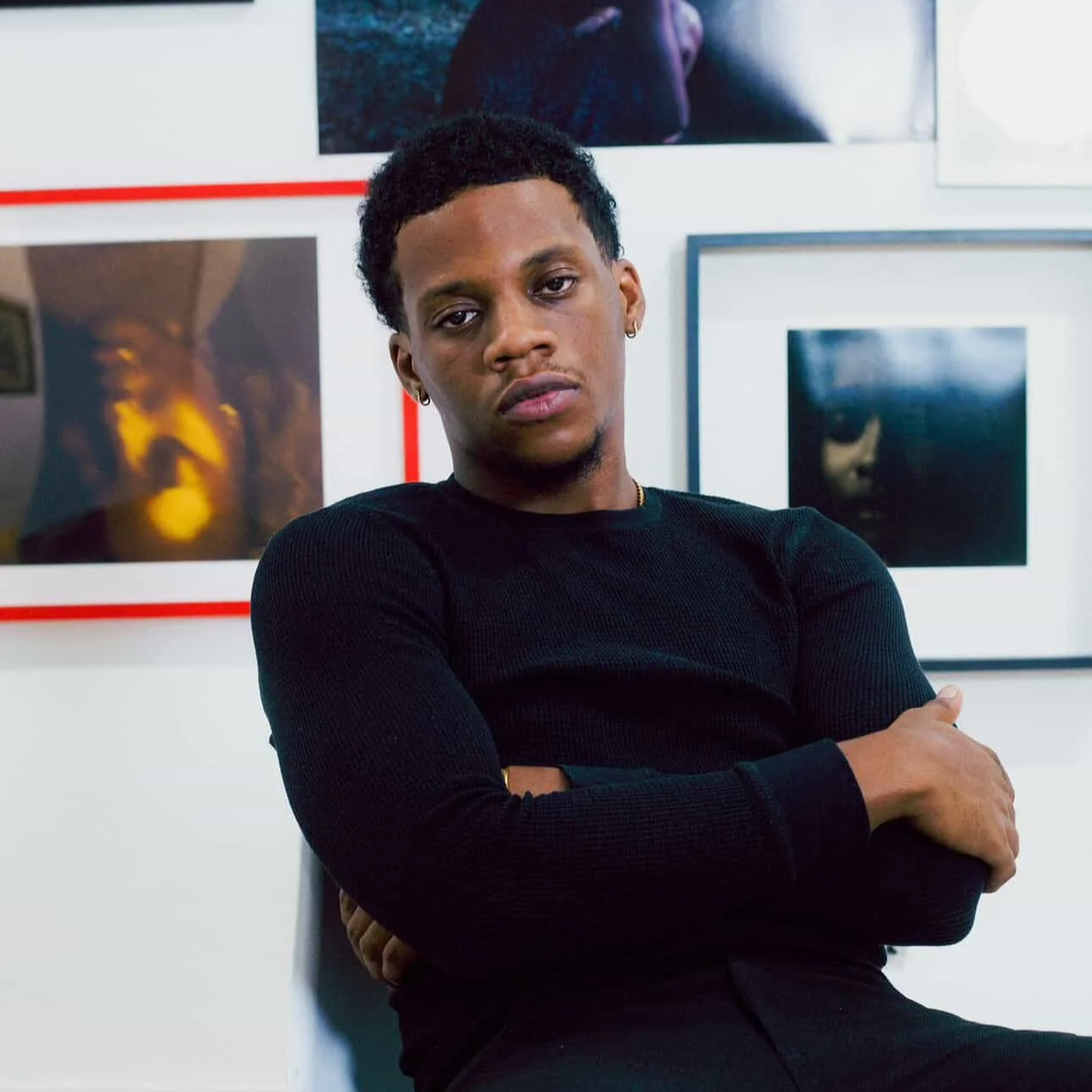
Rodney Ellis
Rodney Ellis, photographer and filmmaker, is like really creative. Read the Q&A from our interview available on YouTube, Spotify, and Apple Podcasts.
So what does your creative practice look like? What goes into your creative process?
I think people think artists do art all day, all night. A lot of it is you just living regular day-to-day life, mundane. I worked in histology at a lab. Well, I was working there.
Being there and, like, being around people who don't do anything like the shit I do and, like talking to them and then being open minded enough in trying to keep some type of humility—I know that my mind works differently and I should be somewhere else, but also knowing that I'm here for a reason and being open to learning new things from people in different ways—just understanding that every situation, there's something you can take from it.
So I live life like that, and then that's where I gain the inspiration to create some shit. Like, for the longest I was just a photographer because that was all that I was feeling. Then I was like, I feel like I got a little more to say. So photography is just not saying that for me. So let me start trying to do this film thing.
And that's how that started. And through that, even if it's just the movies I enjoy—that's what my inspiration is and how my cinematography and all of that shit is like, it's just from stuff I like. So it's just living. You just learn as you breathe. You just learn as you go, and you just add to whatever it is you're doing in that moment.
Like the next thing I may do, I may go start a podcast. It's just important to try to take things from your experiences. Like, don't just live them. Don't let shit go in vain.
One thing that I thought was really cool when I was doing some research on you is—you talked about on the Plenny Studios website that you didn't have training—like technical training—and you wanted to start something on your own. That's a very brave thing to do because it's hard as artists sometimes to be like, "We got to have academic training. We got to have all these connections." What made you want to just start your own thing?
I'm around a lot of people who do their own thing. So I think it was just, like, it's just common practice amongst all my friends. I got a friend. Her name is Kendra Lee.
She goes to school, and she's from Alabama. She took a big leap. She was like, "I'm going to start this production company, and I'm going to be serious about it." And she did that in undergrad, and now she's in LA, and she's doing her thing. And then I got AC, I got Jonathan, and I got Chloe, like all these people around me who are so serious about what they do in any type of way. Like one is a manager at Amazon.
One works on TV sets, and she does her thing in that way. Everybody takes their shit so seriously. And it was like, "If I want to do something, I want to take it seriously." I didn't want to just half-ass it because I didn't go to the school and do the years of studying. Some people have been into photography their whole life, and I don't want to come into a space and disrespect it. Like, I really value people who take their things seriously. So me knowing that—I'm in the beginning stages of photography, like I just started doing this like four years ago.
So I can't come in and say, "I'm a photographer. I'm the greatest photographer. I'm the best photographer in Memphis." Like, I can't come say something like that when I'm like, I don't even know the history. It would be disrespecting the art. You just gotta have respect for the spaces that you're in.
So it's like, me doing my own thing is me being like, I can do what I want to do or how I want to do it. If I want to call myself a director over here at Plenny Studios, I am that.
But, if I were to go to, like, NBC: hey, I don't know what anybody on set is doing. I can't call myself a director.
Like, I got so much more to learn, and I'm learning that through Plenny Studios as I work. And I need to do more. Like, I'm getting more into sound. I shoot silent films.
I'm getting more into the sound aspect. I enjoyed putting sound together for my last film. Now it's time for me to start actually learning that. So when I'm actually on the set, I can have a conversation with everybody. If I got a stylist on set, I got a taste in styling, so I can talk to you about styling.
But then I got my guy on set who does set design, I can talk to him about set design because I've learned set design, and that's what a director is. You need to have a taste in everything on the set. So I'm still learning everything that goes into it, and I feel like I can do it at my own pace, and I can build something from the ground up, and when it's there, it’s going to be there. I'm going to know how to do everything that goes into it.
I like the perspective of always learning. That's something that's very important. And I want to talk about “God's Son,” your film. I love the style. It's very moody and gritty, and I would say it's very conceptual. It's like capital A art, you know. What did you learn from that process, and what was the idea behind “God's Son”?
I really appreciate that, too. I'll talk about the idea first. I'm 26. I feel like in the last year, it was the year that I can say, "Yeah, like I grew up the most."
Like how everyone has that point, that ceiling they hit where it’s like, "Shit makes sense now." I think that was what it was, going through the age of 25, turning into 26, I think that's what it was for me. And the biggest thing I learned was just like something that my mom had always told me, "Sometimes you got to just release."
Like it was this surrendering thing. This was the whole theme of it. If you don't surrender, eventually you're going to die on your own sword. And that's what happened to the character at the end. That was something I was learning in my own life at that time.
And that's what I learned, like, art is. I'm still learning art.
That's what art is. It's just like being able to translate whatever you're going through, your own experiences. I think that's what a lot of people be like, trying to force a little shit and make it art. And it's like, for me—the vulnerable shit, it is what it is.
Everybody is going through the same things. We are connected through that. “God Son's” was a way of saying, "Hey, we all are going through the same exact phenomenon in some way, and we all just at some point learned what surrendering was and was okay with whatever our life is and what it's going to be like."
I became okay with the fact that I had to work at a lab for a little bit. I taught high school for a little bit. I had to be okay with that. Like, shit is what it is. Like everybody's story different. And eventually, you just learned that you got to accept whatever cards you're dealt.
And that's what I was trying to convey with that. And luckily, the character—bro, I gave like simple directions, and what Leonard was able to do with what I gave him showed me exactly that he has been through that exact same thing. Like I couldn't get down and tell him what to do in terms of his body movements for those scenes, and the fact that he was able to do exactly what I needed him to do off of just me explaining to him what I'm going through in my life right now, and this is what I'm trying to shoot—
He was just able to do it. And he said he felt it. He was like, "I'm in the exact same space right now, so I can do that perfectly for you." And that was just like confirming for me. That is what I learned through the whole process of it. I was like, "It's okay to just be real sometimes."
Just to not be scared to be vulnerable. Like I learned the importance of that because a lot of people are going through that same exact shit. Like, one guy in my exhibit after watching the film—because after I showed it the first time, I put it on loop for people who weren't able to catch it as I showed it
So I came back as it was ending for like the second or third time—and the guy was in there like crying, bro, like letting it out. Like boo-hooing.
That's what you want. Please cry for my art.
Yeah. Once it happens, you're like....what?
It was cool. And we talked, and we had a little moment. It showed me that the shit I'm trying to do, I'm doing it the correct way.
What I love about your portraits and your film is that nothing is posed. It's really a slice of life. And like you said, it's vulnerable, which is a strength. When you're shooting a photo, what kind of emotions are you hoping to elicit? Or do you even have an expectation when you're shooting?
No. Okay, so I only shoot on film. I'm not tech-savvy. Film was the easiest thing for me to learn. So when I first started shooting, I already knew certain stuff wasn't going to come out because I can't look at it.
I didn't know how to use the cameras and things like that. So I got real comfortable with just taking whatever I get out of, like a roll, and making it into whatever I needed it to be. And, when shooting, I just kind of have this really loose concept. I know what we're going out here and what I'm trying to do, and I'm explaining to my models or whatever, and whatever we can get from it.
I know I'm going to go home, and I'm going to like, make this into what I needed to because you just going, you shoot whatever you're feeling in the moment. I don't really want everybody going into it with this preconceived thing of how they need to come acting and what mood they need to have. I just want you to kind of take what I'm about to tell you, and ask: How are you going to translate it? And that's just how you feel about that thing in that moment. And I'm going to capture that. It just works out. It just goes together.
I don't put a lot of thought into it. I think that's what helps me a lot.
As you were talking about earlier, you're a learner. When you have a new thing you want to learn, how do you consume? How do you learn?
When I get fixated on something, like my whole perception of how I view things change. So, if I'm fixated on a sound in the moment, I'm going to watch a film, and I want to pay attention to just the sound. But it's not like me watching it, looking for the sound. I just kind of watch it.
And that's what I'm focused on. Since I'm fixated on it already, that is what I pay attention to. So like, right now, I'm really into chase scenes. I don't know why. On foot or in car. I like chase scenes right now.
With me being so into that right now, I've been drawn to action movies. I got to watch action movies. I can't watch anything else right now. I can't sit down and watch any other type of film.
My perception of how I view things change when I want to learn it, right? And it makes me just pay attention to it a little more, you know?
Yeah, it's almost like there's no passive watching. You're constantly looking for something for inspiration. I've never heard anybody say they're into chase scenes.
What's that about?
My favorite movie is “Juice.” It's got Omar Epps, Tupac. It's a cool movie. “In Juice,” there's a scene where—all of them are in high school—and they were skipping high school at this little arcade or whatever. And the police came, and all them just ran and struck out.
It just showed each individual person's chase scene. I really liked what he was doing with the camera. The cinematography of that scene was cool. In both of my films—"Hold On, Be Strong" and "God's Son"—I started both of those off with chase scenes as well.
Like it's just something that I've just always been into doing. I don't know what it is about. But I'm learning that every director has their "shot."
I'm still learning the shit, and it seems like such simple shit. If I was to explain it to another person who's into film, they'd be like duh. But I just picked up on it. So, I'm learning like—the trunk shot. Like a shot from the trunk of a car.
Some like shot of them from the back, and they're walking through a crowd. Everyone has their thing, like their shot. And I was like, bro, what is my thing? I'm not trying to, like, actively pursue and find it, but what's my shot?
Yeah, that's really cool. You kind of have to find your style. You know, you said you started four years ago. How do you think you've evolved in these last four years? Because you started when you were in your early 20s. And I know when I was in my early 20s, I didn't know what the fuck I was doing right. How have you grown as a person through this creative process?
You can tell where I'm at in life based off my creative process. When I first started, I was in college and I was doing grass shoots. I needed some quick change, bro. After school, I was gonna go to PT school, and I was going to just, like, do my thing. And then, with the grass shoots, I got really bored of them.
And I started just fucking around. Me and this girl was dating at the time. So I took some pictures of her and that was my first time styling someone and putting them in the setting. I came up with a little concept. And I was like, "Just frolic." The shit was so fun, and the images came out, and I just really liked them.
And I was like, "Man, this is fun. Okay, I could do this on a more serious note."
So, from there, I went ahead and took a chance. I didn't go to PT school. I didn't apply to no graduate programs or nothing. And I'm like, "Okay, what the fuck am I going to do?" And that's how I ended up in the teaching thing. Because it was something where I still had time for doing photography on the weekends. And I got off work at 2:30 so I could do shit after work. I had summers off. I was like, "Okay, I can do this. I can do photography." And my work at that time, it was real dark.
But in my life, bro, I hated my scenario. Like I hated the fact that I was stuck at school teaching, back at the school that I went to for high school. Nobody wants to say no shit like that. Unless teaching was your dream from being in high school, everybody would look at the teachers who came back and talk like, "Why the fuck did you come back?"
So you had like a little shame about it, maybe?
That's a great word for it because I knew I could be doing "more." But I ended up getting to a point where, like, what is more? And that was what my whole first exhibit project I really did was "Hold On, Be Strong." That was about like, "What are you even chasing?"
"What is this more thing that you're so, like, obsessed with?"
I couldn't even pinpoint it. Because it's not more money. Even if I was to get more money, what would I even do? Like I bumped into this random ass man. And this is on a tangent where I bumped into this random ass man amidst all of that. And it was like this festival going on.
He was mysterious as hell. He had on black shades. He was like, "I've lived in 50 places." And he just said the thing he learned about all of that was, if you're miserable, you're miserable. That misery's going to follow you to each place you go. And he said the happiest he's ever been is in Memphis.
This is not nowhere near the best place he's lived in in terms of nightlife, in terms of views, in terms of food. He wouldn't even rank it top. But this is his place. He's found his inner happiness here.
This was while I was shooting this whole thing about, "what am I even trying to go after? Like, what am I chasing?" And he and I just—it was meant for me to meet him, right? Like he said exactly what I needed to hear in that moment because he was like, "I'm not chasing this shit."
The shit I'm chasing is like right next to me. I don't even fully know myself. Like, what am I trying to move to Chicago for?
I'm gonna go there and be lost just as lost as I am here. Like I don't have anything figured out. We were talking about how my work has this linear thing as I discover and figure out more of my work—kind of goes right along with it. And I take these super long breaks where I don't even touch cameras.
I haven't touched the camera in like three months. I just took some pictures for a friend's album cover last weekend.
I used to always think that artists worked all the time until I met artists, and I was like, "Bro, you do this, too."
You have to have space. To actually think. Because when I stop and think with no distractions, and I'm just thinking and it's just silence, that's when ideas start coming up. And it's like, "Oh, I don't have to constantly consume art to like have ideas." The idea is me. That's my inner voice. It's not other people's voice.
Like you said, you were chasing something. It's like you're trying to find your purpose. With Plenny Studios, do you think that's aligned with your path? What do you hope to get out of Plenny Studios?
Just enjoyment. Like for real.
This goes back to me not wanting to disrespect the art—I don't bank on this like changing my life. I'm really, like, sciency. Like, I really one day do want to go back to school and become that physical therapist. Like, very soon, probably. With it, I just really know that it's going to take me places because it's taking me places already. And that's great. That's beautiful.
And I'm very blessed for the opportunities and connections and things that art brings me. But I really just enjoy doing it, and like, as long as I can keep doing that. It's an optional thing to me. Art itself is optional. You don't really have to like—the world needs art, but in terms of creating it, unless it's your like thing, your passion and your calling, like that's all you've done and is all you know—and even then, like, you really don't have to do that shit.
When I do decide to pick up the camera, I'm just translating the shit I recently went through during the time I wasn't doing it. And that's all. So one day I can see myself wholeheartedly, just like, "That's just something I used to do. It is what it is."
So as long as I'm constantly enjoying it, and while I'm going to do it, I'm going to respect it and do the research and take it as seriously when I am doing it. But I don't really look forward to getting anything more out of it in that.
I love that perspective. When you're younger, art is about enjoyment. And then all of a sudden it's like, "Oh, I have to make it. I could make money off this." But then that gets in the way of enjoyment because that's stressful as fuck. Especially like if you don't have rich parents, you know, so I love that perspective.
So I have one last question. It's my favorite question to ask artists. What is your dream project?
I want to shoot a full film—a full hour and a half, two-hour ass film. Like Tarantino shit. I think I want it to be horror or like horror-based. Like I want it to be some type of suspenseful jump scare film.
Like, that's my ultimate ultimate thing. And as I work on different people's sets as an assistant or behind the scenes or whatever the case may be, I'm just taking little stuff from everybody's set, and being like, "Okay, I need to have this on my movie set. This needs to be on my movie." I want to put together a full ass film.
I may stop after that. If you ever see that I done put out a feature film, hour and a half long, Netflix—like, I'm done. Don't expect nothing else from me.
Or I want to make like furniture or something. I've always been into chairs and shit. I want to make some cool chairs.
Where to find Rodney
Instagram: @rodneyellisd